
Attribution Analytics
Marketing Dashboard Metrics: How to Build Executive-Proof Dashboards
Most dashboards fail in exec meetings. Learn how operators define metrics, assign ownership, and maintain QA so leaders can trust the numbers.
A step-by-step Shopify BFCM guide for DTC operators. Learn how to plan your Black Friday sale, manage offers, creative assets, and inventory, and run post-sale reviews that drive smarter, more profitable campaigns year-round.
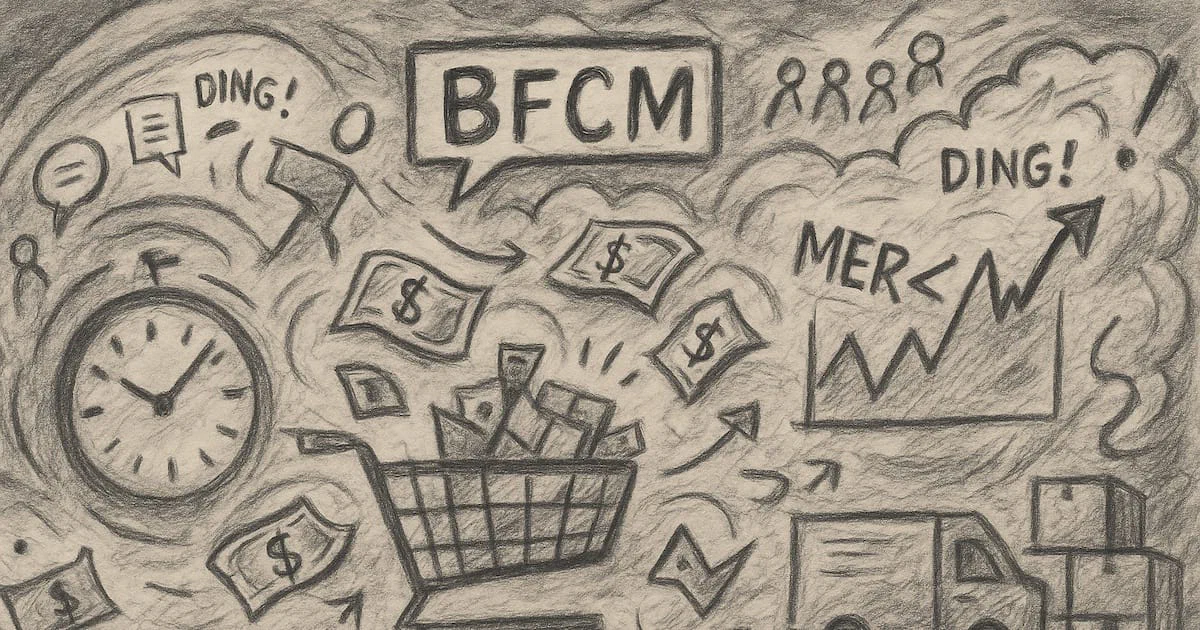
Black Friday–Cyber Monday (BFCM) isn’t a marketing holiday; it’s an operational stress test.
For one weekend, your Shopify store runs at maximum capacity. Weak inventory controls, sloppy discount logic, and vague third-party logistics provider (3PL) assumptions stop being manageable annoyances and start cutting into profit.
In 2024, U.S. online Black Friday spending hit $10.8 billion, up 10% year over year.1 Shopify merchants alone processed $4.1 billion in sales in 24 hours, a 22% year-over-year increase.2 Direct-to-consumer (DTC) brands captured over $2 billion across the BFCM weekend.3
And yet, despite record-breaking top-line revenue screenshots floating around Twitter, many operators finish the week wondering if they actually made any money after ad spend, fulfillment surcharges, and January returns are reconciled.
This guide fixes that. It’s built for operators who measure in margins, service-level agreement (SLA) adherence, and lead times, rather than likes and impressions.
If you only take one idea from this playbook, take this one: treat BFCM as a controlled operating system, not a burst campaign.
The finance team sets the margin limits. The marketing team builds the offer inside those limits. The operations team prepares the warehouse and carrier plan before demand spikes. The support team prepares the responses before customers feel the strain. When one team outruns the others, BFCM turns into a cash-flow problem.
The guide follows that order. First, you set the financial rules. Then you build the assets and automations that support them. Then you run the weekend like a control room. Finally, you turn the results into next year’s process.
Consider a $15M wellness brand that approached last year’s BFCM with a simple goal: “Break $1M in weekend revenue.” They ran a flat 30% sitewide discount to maximize conversion rates.
Marketing celebrated on Cyber Monday. They hit $1.2M in gross sales. But the operational reality hit the P&L in January:
The Net Result? The brand generated $1.2M in revenue but walked away with just a 9% net margin — barely covering fixed overhead and drastically starving their Q1 working capital.
Top-line revenue is a vanity metric during BFCM. Profitability is the only scoreboard that matters.
The defense against this kind of margin collapse isn’t found in better ad copy; it’s built through rigid operational architecture months in advance. The following four-phase protocol is designed to keep your systems intact, your teams aligned, and your margins protected from September forecasting through December reconciliation.
Operator Principle: Plan like finance, execute like marketing.
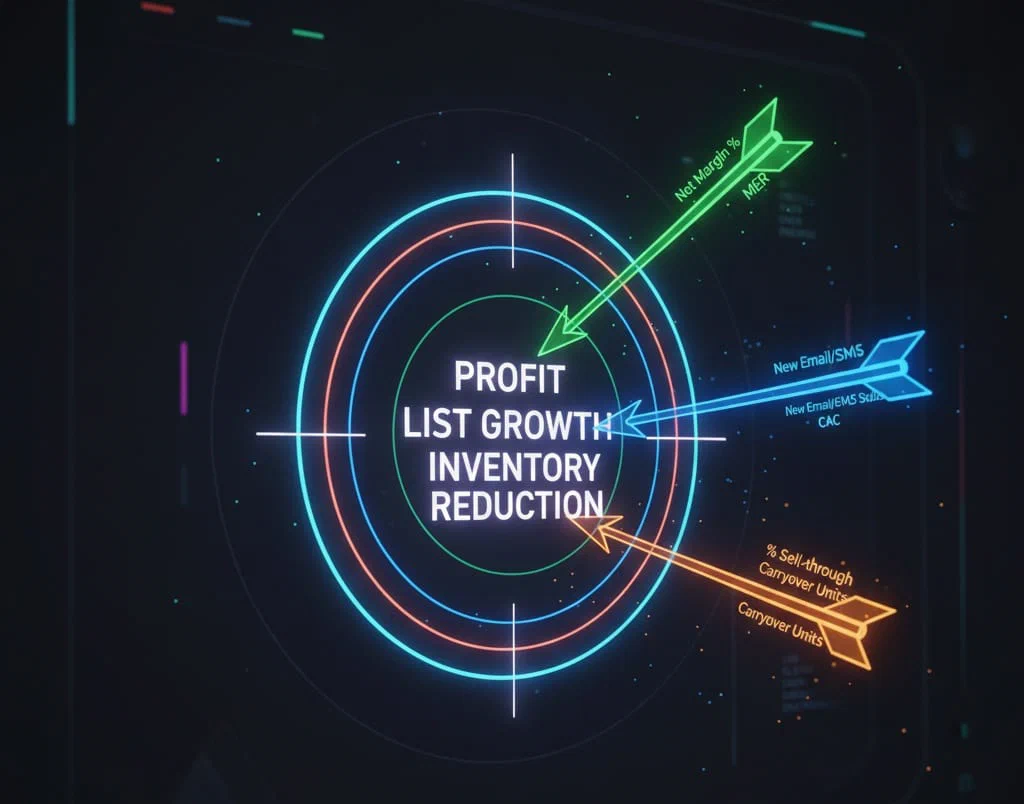
BFCM only works when your metrics match your mission. The most common organizational failure is when marketing optimizes for top-line revenue while finance optimizes for margin, and operations optimizes for throughput. You must choose one primary organizational goal and align all departmental actions to it.
This is not a reporting exercise. It is a capital-allocation decision. If the company says it wants margin but rewards top-line screenshots, the rest of the plan will drift toward unprofitable volume.
| Objective | Primary KPI | Secondary KPI | Example Target |
|---|---|---|---|
| Profitability | Net Margin % | Marketing efficiency ratio (MER) | ≥ 25 % margin, MER > 3.0 |
| List Growth | New Email/SMS Subs | Customer acquisition cost (CAC) | +30 % list growth, CAC < lifetime value (LTV)/3 |
| Inventory Clearance | % Sell-through | Carryover Units | 90 %+ clearance on seasonal SKUs |
MER = Total Revenue ÷ Total Ad Spend.
Monitor this hourly during the peak BFCM window. If MER dips below 2.5, it’s a leading indicator that your offer isn’t resonant or your creative is leaking traffic, and you must intervene before you burn cash. DTC founders are heavily shifting focus from “record revenue” to profit-first planning.4

Your discount is not a marketing tactic. It is a cost line. If you set it without modeling the operational consequences, you give away margin before the weekend starts. Run this formula before you lock the offer:
(Gross Margin % × Forecast Sales Volume)
– (Promo Cost + Fulfillment Variance + Expected Returns)
= Projected Gross Profit
Pull the inputs from your systems:
Discount % × Forecast Revenue. This is simple math.Example Application: If you forecast $400k sales at a baseline 60% gross margin and offer 20% off:
Calculation: (0.60 × $400,000) – ($80,000 + $25,000 + $15,000) = $120,000 net profit (A 30% net margin).
Finance Shortcut: If your Promo Cost + 3PL Variance exceeds 50% of your gross baseline profit, your “sale” is eating you alive. Restructure the offer immediately.
Building a single sitewide discount trains your best customers to devalue your brand. Nine precise permutations ensure every cohort is monetized efficiently without leaving money on the table.
| Segment | Primary Offer | Backup Offer | VIP Angle |
|---|---|---|---|
| New Customers | Sitewide 20 % off | Free Shipping + Baseline Gift | “First-Time Buyer Early Access” |
| Returning Customers | Tiered Spend (15/20/25 %) | Loyalty Point Multiplier | “Member-Only Bonus Gift” |
| Lapsed Customers | “Win-Back Bundle” | Free Gift on Any Order | “We Miss You + 20 % Off” |
Average discount depth across the ecosystem hit 19 % on Black Friday vs 9 % pre-BFCM.5 Use this to anchor your range.
Governing the Marketing Department: This is where operational governance meets creative friction. Marketing will inevitably argue that a 3x3 grid is “too complicated” to communicate in ads, or that “sitewide 30%” drives higher click-through rates (CTRs).
As the operator, you must hold the line. Present the Margin Reality Formula to your marketing lead and mandate that the 3x3 grid is a financial constraint, not a creative suggestion. Pre-build these discount codes in Shopify Discounts, explicitly name them by segment, for example BFCM_RETURNING_TIER2, and sync those exact codes with Klaviyo flows so marketing is forced to work within the guardrails.

Inventory is working capital locked in a warehouse. Operators cannot afford to stock out on hero products, nor can they afford to carry dead stock into Q1. Model Conservative, Base, and Aggressive scenarios to protect cash flow.
This is where seasonal planning becomes a balance-sheet exercise. Every extra unit you buy ties up cash before BFCM starts. Every stockout forces you to waste the most efficient demand window of the year.
| Scenario | Sales Volume | Units Needed | Buffer |
|---|---|---|---|
| Conservative | –20 % vs LY | 80 % LY units | 5 % |
| Base | Equal to LY | 100 % | 10 % |
| Aggressive | +30 % vs LY | 130 % | 15 % |
The 3PL Reconciliation Deadline: By October 15, you must systematically reconcile your Shopify available stock with your 3PL’s warehouse management system (WMS). Lack of real-time visibility and “ghost inventory” is a top failure point during BFCM, leading to immediate backorders and furious customer service tickets.6
Operations Preparation Checklist:
If marketing succeeds, support will break. Prepare the safety nets:
60 % of consumers start shopping before Thanksgiving;7 42 % start before November.8 If you are planning in late October, you are already too late.
| Timeline Focus | Operational Objective |
|---|---|
| Sep 1–7 | Finalize Margin Reality Formula & forecast inventory purchase orders (POs) |
| Sep 8–30 | Lock 3x3 Promo Grid; issue creative briefs to design team |
| Oct 1–20 | QA all assets; pre-build Shopify flows and schedule Launchpad |
| Nov 1–10 | Warm-up emails + VIP Early Access drops |
| Nov 25 (BFCM) | Control room execution + live MER monitoring |
Core Idea: Systems ship sales. Creatives just decorate them.
Phase 1 set the financial rules. Phase 2 turns those rules into assets, schedules, and automations the team can ship without improvising under pressure.
A standard 5-day sale window produces a large asset load. If the team builds it on the fly, links break, discount codes misfire, and people burn out before the sale reaches full volume.
| Channel | Volume Target | Purpose & Cadence |
|---|---|---|
| 8–10 deployments | 2 warm-up, 3 launch, 3 reminder, 2 final hour scarcity | |
| SMS | 4–6 deployments | VIP Early access, Live launch, Abandoned Cart reminders |
| Meta Ads | 10–12 unique variations | Cold outreach, retargeting, user-generated content (UGC) social proof, high-conversion carousels |
| Google PMax | 3 distinct asset groups | Product-specific, Sale/Promo logic, Brand defense |
| Organic Social | 10–15 touches | Stories, Behind-the-Scenes warehouse packing, Customer reviews |
The Creative Brief Mandate: Every single asset must trace back to a unified Creative Brief. The brief must explicitly state the objective, target segment, discount code, format dimensions, individual owner, and hard deadline. One hour spent writing a rigorous brief saves five hours of panicked Slack revision loops the week before Thanksgiving.
Do not rely on human memory to turn discounts on and off.
Remember: 79% of BFCM traffic comes from a mobile device. If it works on desktop but breaks on iOS, you lose.9
Elevate your strategy outside of standard paid media to diversify acquisition costs.
BFCM weekend is not the time to rethink the plan. It is the time to execute it, watch the numbers, and respond fast when a threshold breaks.
This is the operational threshold between preparation and live management. Up to this point, the team has been building the system. Now the system has to carry load without forcing leaders into ad hoc decisions.
You need a central command dashboard visible to all department heads. Stop refreshing the Shopify total revenue counter; it doesn’t tell you if you’re making money or breaking systems.
| Operator Metric | Source | Review Frequency | Critical Alert Threshold |
|---|---|---|---|
| MER | Meta Spend + Shopify Rev | Hourly | Dips below 2.5 |
| Average order value (AOV) | Shopify | Hourly | –10 % vs forecast model |
| Fulfillment Lag | 3PL WMS / ShipStation | 2× daily | Orders unfulfilled > 48 hr |
| Customer service (CS) volume | Gorgias / Zendesk | Daily | > 2× baseline expectation |
Wire these thresholds into Slack using Zapier. If MER drops, the marketing lead needs an immediate notification to pause underperforming ad sets. If Fulfillment Lag spikes, operations needs to authorize overtime with the 3PL instantly. Black Friday represents 4.1 % of total holiday ecommerce revenue, so system downtime or ad inefficiency compounds rapidly.10
Read more: Marketing Dashboard Metrics: How to Build Executive-Proof Dashboards
During peak volume, noisy Slack habits create duplicate work and slow incident response. Control the communication environment:
#bfcm-ops-live Slack channel. Only department heads may post. Everyone else is read-only.Establish a fixed meeting and update cadence to eliminate the need for constant “status check” pings:
Operator Shortcut: Track every incident, mistake, and broken system in a single centralized Google Sheet titled “Next Year’s Fix List.” Do not wait until January to try and remember what went wrong.
The sale isn’t over when the discounts turn off; it’s over when the data is reconciled and the processes are updated.
This final phase matters because BFCM should fund next year’s competence, not just this year’s revenue target. If the team closes the weekend and moves on, you keep the sales and lose the learning.
Extract the true data from Shopify Analytics and QuickBooks by mid-December to confront the reality of the Margin Reality Formula you built in Phase 1.
| Post-Mortem Metric | Success Baseline |
|---|---|
| Actual MER vs Forecast | Within ± 0.2 variance |
| Final Net Margin % | ≥ 25 % (or target goal) |
| Average Fulfillment Delay | Under 48 hours for 90% of orders |
| Refund & Return Rate | Maintained under 4 % |
| Email/SMS Unsubscribe Rate | Spiked less than 1 % |
A high revenue number with a 7% return rate and a 12% net margin is a failure of operational planning.
Do not let the pain of the weekend go to waste. Before December 15th, convene all department heads for a mandatory post-mortem.
Managing the Friction: Your leads just survived a grueling 5-day spike; they will enter this meeting defensive. Set the rule immediately: We are here to audit the system, not attack the operator. If a massive influx of orders delayed fulfillment, the failure belongs to the SLA forecasting model, not the warehouse manager.
Create a shared Notion matrix categorizing: What Worked / What Broke (Systems-Level) / What Was Redundant / Next Year’s Action.
Feed these specific action items directly into your Q1 operations calendar and your Q3 Inventory Planner for next year. Assign clear owners and rigid deadlines to these systemic fixes. Institutional memory expires fast; establish your new protocols while the friction is fresh.
The companies that get calmer every BFCM do one thing differently: they treat the post-mortem as the first planning meeting for the next cycle. The fixes become owners, deadlines, budget assumptions, and SLA revisions while the evidence is still fresh enough to trust.
Do not wait until September to find out whether your BFCM plan is real. Start now with three moves:
If your team cannot do those three things in one working session, you do not have a playbook yet. You have a promotion plan.
Get the exact checklist and creative brief template that turn chaos into control — built for Shopify DTC operators.
No spam. Unsubscribe anytime.
https://news.shopify.com/shopify-merchants-break-records-black-friday-2024 ↩︎
https://www.modernretail.co/marketing/dtc-briefing-how-startups-are-factoring-profit-into-their-black-friday-calculus ↩︎
https://www.finaloop.com/blog/why-this-2024-bfcm-is-a-lesson-in-inventory-cash-flow-and-financial-data ↩︎
https://business.adobe.com/resources/holiday-shopping-report.html ↩︎
https://forgedigitalmarketing.com/how-dtc-brands-prepare-for-black-friday-and-cyber-monday ↩︎
https://redstagfulfillment.com/ecommerce-sales-percentage-on-black-friday ↩︎

Frequently Asked Questions
By early September. Creative and inventory workflows require backward planning of 8–10 weeks before launch to ensure 3PL and supplier alignment.
Between 3.0 and 4.0 for most $2M–$50M direct-to-consumer brands. Anything under 2.5 during peak velocity requires immediate diagnostic attention to the offer or creative.
8–10 minimum over the 5-day period: 2 warm-ups, 3 launch, 3 reminders, and 2 final hours, tightly segmented to protect deliverability.
Continue Reading